
Why the Creator Economy Needs an Operating System, Not a Platform

Updated: May 8
By Latif Sim, Co-Founder, BeLive Studios
We've spent a decade calling them platforms.
TikTok. YouTube. Instagram. Patreon. Substack. Twitch. Spotify for Podcasters. Each one branded itself as the home for creators, the place where careers get built, audiences get found, and businesses get made.
Talk to any creator working at scale today and you'll hear the same thing. They don't have a home. They have a stack of seven different homes that don't talk to each other, and a full-time job stitching the seams together.
This is the part of the creator economy that doesn't get written about often enough. The headline numbers, fifty million creators, hundred-billion-dollar markets, top earners pulling in eight figures a year describe an industry that looks like it works. The operational reality, for almost every creator below the top fraction of a percent, describes an industry that mostly doesn't.
I want to make a specific argument in this piece. The reason most creator businesses don't compound the way other businesses do is that the creator economy was built as a constellation of platforms, each optimising for its own surface, with no connective tissue between them. What it actually needs and what the next decade of creator businesses will be built on is an operating system.
Platforms give creators reach. An operating system gives them a business.
What's actually broken
A working creator business in 2026 has at least seven moving parts. Funding for new projects. Production capacity to make them. A way to validate ideas before committing real capital. Distribution across multiple surfaces. Monetization that flexes between models. Audience and data ownership. And IP rights structured for long-term value.
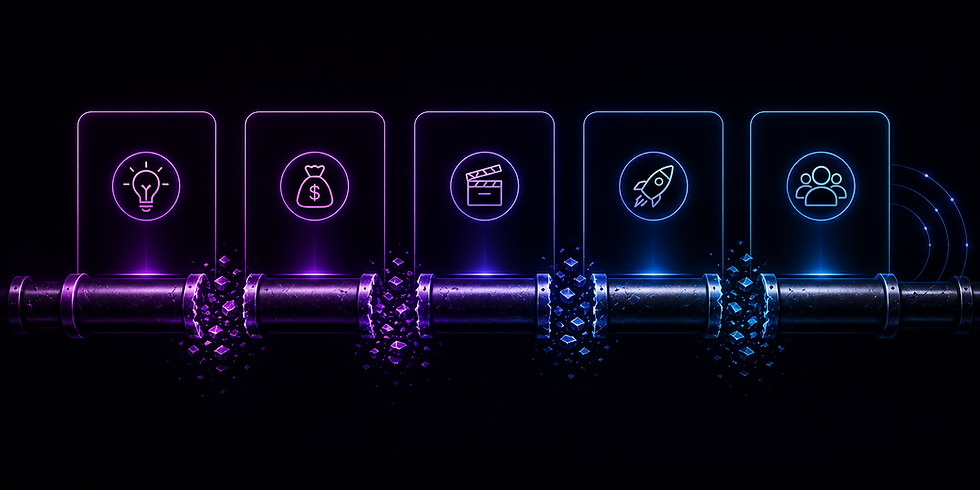
Almost every existing platform handles one or two of these. None handle all of them. And the spaces between them, the workflow, the data flow, the decision logic that ties one to the next are where most creator businesses quietly die.
A creator wants to make a new series. Where does the money come from? Probably their own savings, possibly a brand deal with terms that compromise the creative work, occasionally an advance from a platform that takes ownership in exchange. Almost nobody in the creator economy has access to the kind of structured project finance that traditional film and television have used for a century, because no platform was built to provide it.
They've raised the money, somewhere, somehow. Where does the production happen? They build a small team, or they outsource piecemeal, or they figure it out themselves. There is no integrated production layer the way there is in the studio system. The infrastructure that made it possible to ship a hundred-million-dollar film in eighteen months has no equivalent in the creator world.
The series is made. How do they know it'll work? Most creators ship and hope. There is no validation layer in the creator economy, no equivalent of test screenings, focus groups, or pre-release audience signal. The platforms have data, but they don't share it back. The creator finds out whether the project worked the same way every previous one did: after launch, when it's too late to change anything.
It launches. Where does it go? Probably TikTok, YouTube, Instagram, and a Discord, with wildly different formats and posting cadences for each. The data on each surface stays on that surface. The audience built on one platform doesn't migrate to another. Every platform takes its own slice of the economics. The creator's own database, if it exists at all is a Substack list and a few thousand emails.
How does the IP get monetised over time? In most cases, it doesn't. The series runs, gets views, drops out of the algorithm, and ends. Whatever brand or character or world the creator built lives on the platform that hosted it, and dies when that platform changes its rules. The creator owns the rights, technically, but has no infrastructure to compound them.
This is the operational reality of the creator economy at scale. Not a unified industry. A scatter of platforms, with creators serving as the integration layer between them.
Platforms vs. operating systems
There's a useful pattern from other industries here.
In software, the early consumer market in the 1980s was a collection of standalone platforms. Word processing on one product, spreadsheets on another, presentations on a third, communication on a fourth, file management on a fifth. Each one was good at its piece. None of them talked to each other. The user did the integration work in their head.
What changed wasn't a better individual platform. What changed was the operating system. macOS, Windows, and later iOS, became the layer that the platforms ran on. The OS handled the connections. Files moved between applications. Identity persisted across surfaces. The user's workflow stopped being a series of disconnected tools and started being a coherent system.
The same pattern repeated in finance. Standalone banking, brokerage, payments, credit, and tax products eventually consolidated into financial operating systems, first via the larger banks, more recently via fintech platforms that made the connective tissue the actual product.
It is repeated again in e-commerce. Shopify is not a better store builder than its predecessors. It's the operating system underneath the storefront, the layer that connects payments, fulfillment, inventory, marketing, and customer data into one workflow. The store is the surface. The OS is what makes the business possible.
The creator economy has been waiting for this same shift, and it hasn't arrived yet. What we have is a generation of platforms that have grown enormously by optimising their individual surfaces. What we don't have is the operating system that makes those platforms behave like parts of one system.
What an OS for creators actually looks like
An operating system for the creator economy isn't another platform. It's the layer that connects the things creators currently have to do across many platforms.
It would handle funding as a structured input, capital that flows toward validated ideas, with terms transparent to both creator and funder, and decisions backed by data rather than relationships.
It would handle production as integrated capacity, a connected network of studios, talent, and post-production resources that creators can plug into without rebuilding their team for every project.
It would handle validation before capital is deployed, real audience signal on a concept before a creator commits a year of their life to making it. Predictive scoring. Test releases. The kind of pre-flight check that traditional film and TV use routinely and the creator economy has gone without.
It would handle distribution across owned and partner rails as a coherent strategy for getting a piece of content in front of audiences, with the data flowing back to the creator and the funder rather than disappearing into a third-party platform's analytics dashboard.
It would handle IP ownership as a long-term asset and making it possible for a creator to monetize the same story across formats, territories, and timeframes, the way every successful franchise in traditional media has done for the last century.
And critically, it would handle the connections between all of these. Validation data should inform funding decisions. Funding decisions should shape production scope. Production decisions should anticipate distribution. Distribution data should compound IP value. The user and the creator shouldn't have to manage any of this manually.
That's the system that turns a creator into a creator business.
What we're building
The reason I'm writing this piece is that we've spent the last several months building exactly this at BeLive Studios.
IPXIS is the operating system layer for creators, funders, and the integrated workflow that connects them. It's where ideas get validated before capital is deployed. It's where structured deal flow connects creators to funders who can actually back their work. It's where production capacity is built in, rather than left to the creator to source. And it's where distribution runs on owned rails through YEON, through partner platforms, and through the integrated network we've been building out across Asia and beyond.
We didn't set out to build a platform. The world has enough platforms. We set out to build the connective tissue that makes the platforms, ours and others function as parts of a coherent system for creators.
The bet underneath this is simple. The creators who will define the next decade in Asian content won't be the ones who got biggest on any single platform. They'll be the ones who built IP that compounds across formats, across territories, across the long timeframes that real franchise value requires. And the funders who'll back them won't be the ones placing speculative bets on individual projects. They'll be the ones investing through a system that gives them structured deal flow and data-driven evaluation.
That system has never existed for the creator economy. We're building it.
The question I'd leave you with
The creator economy isn't broken because creators don't work hard enough or because audiences don't engage enough. It's broken because the infrastructure underneath it never finished being built.
The next ten years in this industry will be defined by the businesses that decide to finish it.
If you're a creator with ambitions beyond the next post, a funder looking for structured access to emerging IP, or a media company trying to figure out how the creator economy connects to your existing business, we should talk.
The door is open at studios@belive.sg.
—
Latif Sim is Co-Founder and Executive Director of BeLive Studios, the team behind YEON and IPXIS. BeLive Studios is a media-tech studio building the future of content in Asia, and a subsidiary of BeLive Holdings (Nasdaq: BLIV).

Comments